
Renovating a home is not just about choosing paint colors or new tiles. Behind every renovation project lies a precise technical sequence, recent regulatory obligations, and budgetary decisions that determine the success of the project long before the first hammer strike.
Energy audit and DPE: two distinct documents not to be confused
Most renovation guides mention the energy performance diagnosis without going further. As of January 1, 2025, the situation has changed for owners of individual houses or buildings in single ownership classified E, F, or G according to the DPE: a regulatory energy audit must be provided in case of sale, in addition to the DPE itself.
This audit presents costed work scenarios to achieve at least class B. Its validity is five years. Anticipating this obligation from the design stage of the renovation avoids having to redo work a few years later to meet the requirements during resale.
A point often overlooked: condominium apartments are not subject to this audit obligation. A co-owner renovating their unit follows a different path, governed by the rules of the condominium and the multi-year work plan voted on in the general assembly. Before defining a budget or contacting a contractor, it is essential to know which category the property falls into, as the procedures, aids, and technical constraints differ entirely.
To explore different types of projects and compare possible approaches, the works proposed by Le Blog de Coco provide a useful overview at this stage of reflection.
Order of renovation works: the sequence that avoids rework
Launching multiple trades in parallel without respecting a logical sequence leads to costly rework. A drywall installer who works before the electrical conduits are installed will have to return to open and then close the walls again. A painter who finishes before the installation of interior woodwork will see their finishes damaged by dust.

The reference technical sequence follows a simple principle: work from structural to decorative.
- Demolition and major works (opening load-bearing walls, foundation work, modifying the framework) before any other intervention.
- Installation of networks (electricity, plumbing, ventilation) in the exposed walls and floors.
- Thermal and acoustic insulation, followed by the installation of drywall or brick partitions.
- Floor and wall coverings, followed by finishes (painting, tiling, installation of sanitary equipment and lighting).
Each step conditions the next. Changing this order, even to save a few days on the schedule, almost always results in a cost overrun greater than the time savings expected.
Renovation budget: hidden costs and contingency margin
Establishing a renovation budget requires listing visible items (materials, labor, equipment) but also those not always mentioned in quotes. The removal and disposal of debris, dumpster rental, asbestos or lead diagnostic costs before demolition, and any necessary electrical upgrades: these items often represent a significant portion of the total cost.
Allowing a margin of 10 to 15% of the total budget for unforeseen expenses remains the most reliable recommendation. An open wall may reveal a degraded beam, an outdated water network, or a complete lack of insulation where the DPE assumed a minimum.
On the financing side, MaPrimeRénov’ reopened on February 23, 2026, for all pathways and all households. The amounts and eligibility conditions vary according to income and the nature of the work. Checking eligibility before signing a quote allows for calibrating the actual remaining charge and adapting the financing plan.
Materials: quality or economy, a long-term trade-off
Cutting back on the quality of insulation or plumbing materials to stick to a tight budget pays off over time. Effective insulation reduces energy bills for decades. A low-cost faucet rarely lasts more than a few years before leaking.
Focusing the budget on structural and energy-related items remains the most cost-effective strategy. Decorative finishes can be improved gradually, while redoing insulation or a concealed network is much more expensive afterward.
Project handover: the moment when the guarantee is triggered
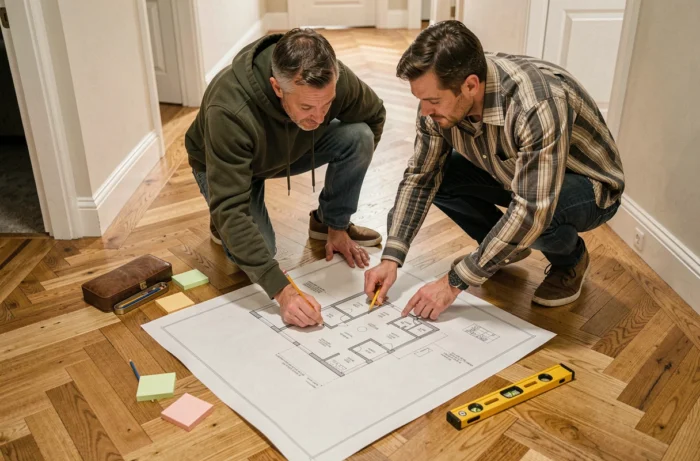
The handover of the work is a formal step that many individuals overlook. It involves checking, room by room, that the services correspond to the signed quote and recording any defects in a report.
This document triggers the guarantee of perfect completion, which obliges the professional to correct all reported issues within one year. Without a dated and signed report, enforcing this guarantee becomes significantly more complicated.
Some points to systematically check during handover:
- Functionality of each electrical outlet, switch, and water point.
- Flatness of floors and walls (a two-meter mason’s rule is sufficient to detect dips).
- Sealing of exterior woodwork, especially at junctions with insulation.
- Compliance of installed equipment with the references listed in the quote.
Each reservation noted in the report must be addressed by the contractor before the final payment. This contractual mechanism protects the project owner, provided it is formalized in writing on the day of handover.
A well-managed renovation project relies less on decorative inspiration than on the rigor of sequencing, the precision of the budget, and knowledge of current regulatory obligations. Properties classified F will be banned from rental starting in 2028, placing energy renovation at the center of any asset strategy for landlord owners.