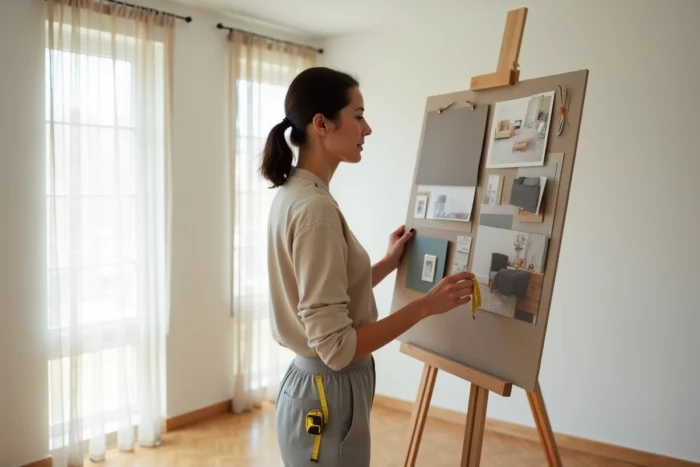
Arranging and decorating a home means organizing a space according to physical constraints (size, natural light, circulation) and aesthetic choices that reflect a lifestyle. Before choosing a sofa or a wall color, the first step is to understand the materials and volumes that influence all subsequent decisions.
Materials and finishes: what truly guides the style of an interior in 2026
The choice of materials precedes the choice of style. An interior described as “Scandinavian” or “industrial” is defined less by a label than by the surfaces and textures that compose it.
Current furniture and decor collections highlight chrome, amber glass, and woods with very visible grains. This retro-sensual mix, noted in several specialized sources, moves away from the overly minimalist interiors that dominated in recent years. Brushed brass is giving way to polished chrome, which is colder but more graphic.
Amber glass, used for lighting fixtures, vases, or partial partitions, brings a golden warmth without resorting to wall paint. When paired with wood that has visible grain (raw oak, uncolored walnut), it creates a contrast between transparency and raw material. To delve deeper into these layout questions and find concrete ideas, you can explore the home section of Zenith Actu, which regularly addresses these topics.
Practically, this means that a decoration budget is allocated differently: less decorative paint, more investment in furniture where the material constitutes the main visual element. A solid oak table top with its visible knots replaces a uniform lacquered surface.

Surface constraints: regulations that condition the layout of small spaces
Decorating a small apartment is not just about “optimizing space” with space-saving furniture. A regulatory constraint frames what can be done, especially in Paris.
The Sanitary Regulation of Paris imposes three simultaneous criteria for a main room: a minimum area of 9 m², a ceiling height of at least 2.20 m, and a minimum habitable volume of 20 m³. All three conditions must be met at the same time. A studio of 10 m² with a ceiling height of 2 m does not comply with the standard, even if the floor area exceeds the threshold.
This rule directly impacts layout choices. Installing a mezzanine to create a sleeping area reduces the ceiling height of the lower area. If this area falls below 2.20 m, it no longer counts as a habitable main room in regulatory terms.
Practical consequences on furniture
In a space constrained by these norms, each piece of furniture must be evaluated based on the volume it consumes. A wardrobe 2.40 m high in a room with a 2.50 m ceiling creates a visual crushing effect, but more importantly, it reduces the feeling of habitable volume.
- Favor low storage (less than 90 cm high) that frees the visual field towards the ceiling and preserves the perception of height
- Avoid deep furniture (more than 45 cm) in circulation areas, as they reduce passages to less than 60 cm, making the room impractical
- Use open shelves rather than closed cabinets: an open piece of furniture allows light to pass through and visually lightens the volume
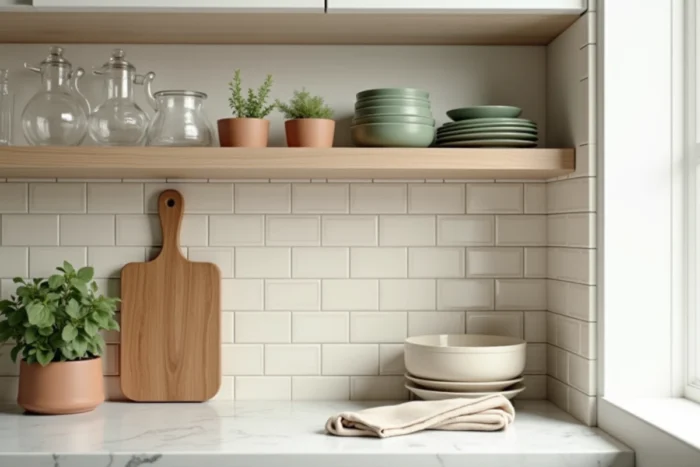
Colors and light: building a coherent palette room by room
Color is the most accessible decorative lever, but also the most misused. The common reflex is to choose a trendy shade and apply it uniformly.
A more effective approach starts from the natural light of each room. A north-facing bedroom receives cold and constant light. A wall painted in pure white will appear gray. An off-white with a yellow tint will correct this coldness without resorting to a saturated color.
Each room deserves its own palette, calibrated to its orientation. A south-facing living room can handle cooler tones (blue-gray, sage green) because the warm sunlight compensates. Conversely, poorly lit rooms benefit from warm but desaturated hues: pale terracotta, rosy beige.
The trap of a single accent wall
Painting one wall in a bright color and leaving the other three white is a decorative automatism that rarely works in small spaces. The stark contrast between a dark wall and three light walls visually cuts the room and makes it appear narrower.
In small areas, painting two adjacent walls (not opposite) in the same medium shade creates a more homogeneous envelope. The eye flows instead of fixating on a single point.
Decoration and objects: the budget that makes a difference daily
Furniture structures the space. Decorative objects give it character. But the relationship between these two spending categories is rarely considered.
Focusing the budget on a few high-impact visual elements produces a more coherent result than spreading the same amount over a dozen small objects. A quality light fixture above a coffee table transforms a living room more than five decorative candles and three mismatched frames.
- A rug defines a functional area (living corner, dining space) and visually anchors the furniture, especially in open rooms
- Textiles (cushions, curtains, throws) allow for seasonal ambiance changes without touching the furniture or paint
- Objects made from natural materials (ceramics, turned wood, linen) age better than those made from plastic or resin, which dull after a few months
The design of an interior is not about accumulation but about selection. A space where each element has been chosen for a specific reason (function, texture, proportion) will always appear more refined than an interior overloaded with contradictory inspirations.
The layout of a house relies on technical as well as aesthetic decisions. Materials, regulatory volumes, light orientation, and budget hierarchy form a framework within which creativity can be exercised with more precision. A well-oriented wall, a piece of furniture at the right depth, and a palette suited to the actual light of the room produce a result that “style” alone cannot achieve.