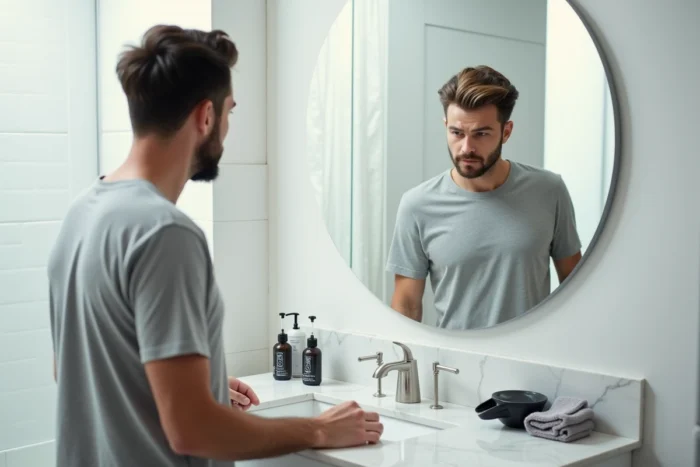
One Saturday morning, you step out of the shower and the mirror confirms what you dreaded: the blonde strands have turned straw yellow, with striped areas at the temples, creating too harsh a contrast with the brown base. The temptation to immediately recolor the entire head is strong, but that is precisely the action that worsens the damage.
Localized color melt: the technique that avoids the helmet effect
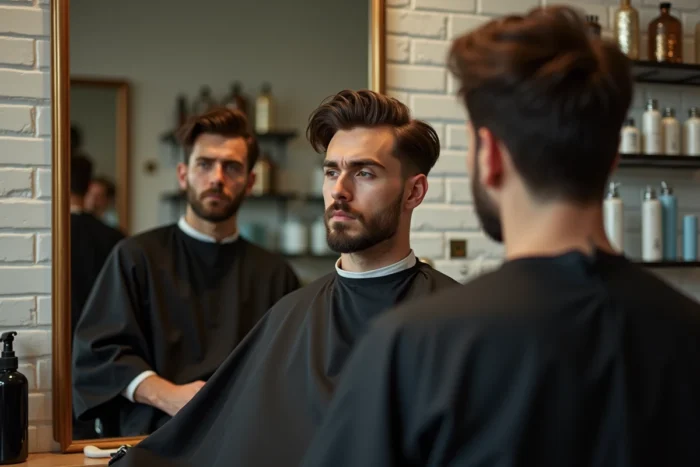
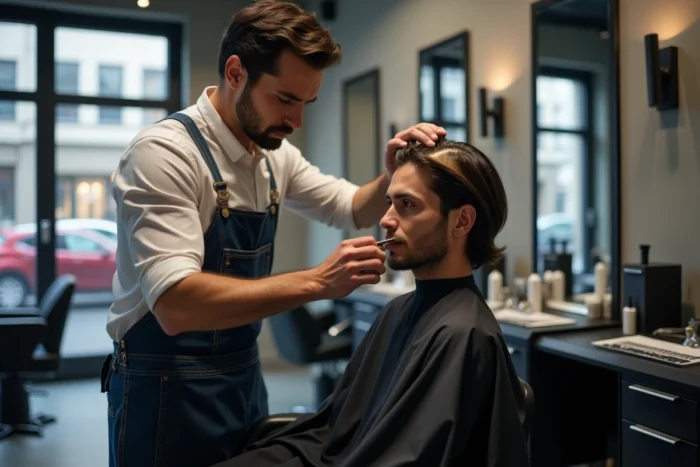
Most guides suggest doing a complete color redo. For a man, this is rarely the right approach. Hairdressers specializing in men’s coloring now recommend a localized color melt: only the overly light or poorly blended areas are touched up, using an intermediate tone between the natural color and the targeted blonde.
The principle is simple. A semi-permanent mix is applied only to the problematic strands, without touching the parts that have taken well. The result maintains depth instead of producing a flat, uniform look.
This melt works particularly well on short to medium cuts, where the failed strands are very visible. On a fade or gradient, you can also find tips on Annuaire Beauté to adapt the correction based on the remaining length on the sides.
Specifically, here’s how to proceed on the targeted areas:
- Identify the overly light or orange strands by isolating them with clips or aluminum foil
- Choose a semi-permanent color one to two shades darker than the desired blonde, never more
- Apply with a fine brush only on the isolated areas, avoiding overspill onto the natural base
- Leave it on for less time than the manufacturer’s recommendation (aiming for a gentle correction, not a complete change)
Purple shampoo after correction: men’s routine to neutralize yellow
Once the correction is applied, the work doesn’t stop. Yellow tones return quickly, especially on hair that has already undergone poorly measured bleaching. The most effective solution without further damaging the fiber is purple or silver shampoo used once or twice a week.
Purple pigments neutralize yellow tones by complementarity on the color wheel. Leave it on for two to three minutes, no more, otherwise the hair may take on an unflattering grayish hue on short strands.
This routine has become the norm in salons to stabilize a men’s blonde after a correction. It avoids multiplying chemical interventions and extends the result of the color melt for several weeks.
Common mistake: using purple shampoo as the only corrector
Purple shampoo does not correct strands that are distinctly orange or a too marked contrast. Its role is maintenance, not rescue. If the strands lean towards copper or red, a pigment correction (the localized melt or a gloss in the salon) must first be done before switching to the maintenance routine.
Gloss for men on failed strands: when to apply it and how to choose the tone
The gloss remains the most recommended option when the result is overall too light or too cool (white, gray, “wig” effect). Unlike a classic color, the gloss deposits pigments without opening the hair scales, which limits damage to an already weakened fiber.
For a man with failed blonde strands, a gloss in ash tones (to break the yellow) or golden tones (to warm up a too platinum blonde) is generally chosen. The choice depends on the undesired result:
- Strands straw yellow: ash or pearlescent gloss, which will reduce excessive warmth
- Strands too white or gray: light golden gloss to bring back natural brightness
- Greenish reflections (common after exposure to chlorine): gloss with copper-red pigments to neutralize the green
The gloss is applied to clean, slightly damp hair. It is left on for a few minutes depending on the desired intensity. Feedback varies on this point, as the application time depends on the porosity of the hair, which is often very uneven after a failed bleaching.
Delay before new bleaching: protect men’s hair fiber
The desire to start over from scratch with a new bleaching is understandable. Current recommendations in salons are clear: wait at least eight weeks before doing another bleaching or highlights. This delay is not arbitrary. It corresponds to the time needed for the fiber to regain a minimum of strength thanks to the disulfide bonds that partially reform.
During this period, replace regular shampoos with sulfate-free formulas and incorporate a protein treatment once a week. The protein (keratin, silk) temporarily fills in gaps in the cuticle, while a moisturizing mask alternately restores flexibility.
Signs that the hair is not ready
If the hair stretches abnormally when wet, breaks when passing through a comb, or has a rubbery texture, the fiber is still too damaged. Attempting a new bleaching at this stage risks causing massive breakage or even irreversible length loss in the most exposed areas.
It’s better to work with semi-permanent colors and glosses during the recovery phase, then return to a healthy base when the hair regains its natural elasticity. A hairdresser can test the resistance of a strand by gently pulling it between two fingers: if it returns to its original shape without breaking, bleaching becomes feasible again.