Most signal losses on a weather station do not come from a hardware fault in the sensor or the console. They result from a combination of factors related to the radio transmission layer, the electromagnetic environment, and, in some cases, the complete disappearance of the network infrastructure that powered the device. Understanding these mechanisms allows for a reliable diagnosis before replacing anything.
POCSAG Protocol and Dependence on a Third-Party Operator: The Invisible Link
The WD range of stations marketed by La Crosse Technology between 2007 and 2021 did not just receive the signal from an outdoor probe. They also retrieved weather data (five-day forecasts, Météo France alerts) via the POCSAG radio messaging protocol, a technology inherited from 1990s pagers.
This protocol was transmitted through the eMessage France network, a subsidiary of a German operator. La Crosse Technology had a commercial agreement with eMessage Germany, but no long-term contract had been formalized with the French subsidiary. When eMessage France ceased operations, the signal was cut off for the entire installed base, which amounts to about 400,000 stations in France.
We observe here a recurring pattern in consumer IoT: the device works, but the service it depends on disappears. No manipulation (removing the batteries, resetting, repositioning the probe) can restore a data stream whose source no longer exists. It is useful to analyze in detail the causes of weather signal interruptions to distinguish this type of structural failure from a simple radio range issue.
La Crosse Technology has confirmed that it does not wish to negotiate a new contract and directs users towards its recent models based on Wi-Fi. The functional obsolescence of these stations is definitive.

Radio Transmission Between Probe and Console: The Real Factors of Signal Loss
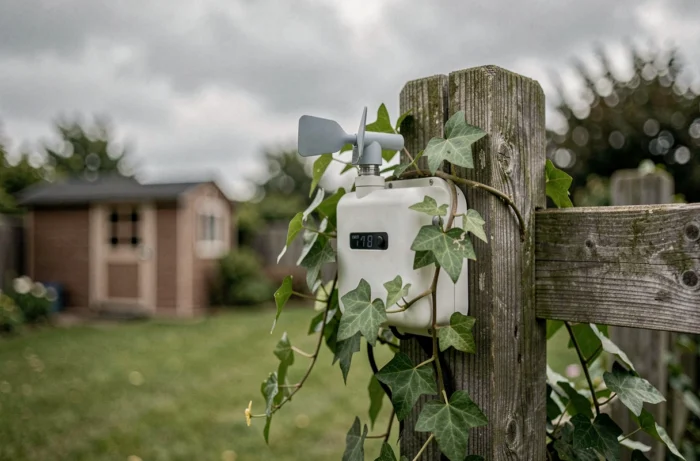
Outside of the eMessage case, most signal interruptions concern the link between the outdoor transmitter (temperature probe, hygrometer) and the indoor console. This link generally uses the 868 MHz band in Europe (433 MHz on some older models), with OOK or FSK modulation depending on the manufacturers.
Actual Range and Material Attenuation
The advertised range (“100 m in free field”) never corresponds to the effective range in a residential environment. Each obstacle between the transmitter and receiver significantly attenuates the signal.
- A reinforced concrete or stone wall reduces the range by half or more, compared to a moderate loss for a drywall partition.
- Double glazing with a metallic layer (enhanced thermal insulation) acts as a filter for radio waves and can block nearly all of the signal if the probe is placed behind a large window.
- Metal structures (steel framework, aluminum cladding, nearby fencing) create reflections and radio shadow areas that are difficult to anticipate without on-site testing.
We recommend testing several locations for the probe before permanently fixing the sensor. A shift of one meter is sometimes enough to get out of a shadow zone.
Local Electromagnetic Interference
Devices emitting on nearby frequencies disrupt reception. The most common sources are baby monitors, certain Z-Wave home automation systems, gate remote controls, and poor-quality switch-mode power supplies. A parasitic transmitter less than two meters from the console is enough to corrupt the frames and cause intermittent losses that the user wrongly attributes to the batteries.
Batteries and Power Supply: A Often Misleading Diagnosis
The first reflex when facing a cut is to change the batteries of the outdoor probe. This reflex is justified, but the way to do it matters as much as the action itself.
Alkaline batteries lose voltage as soon as the temperature drops below 0 °C. In winter conditions, a probe powered by standard alkaline batteries may stop transmitting while those same batteries would still work perfectly at room temperature. Lithium batteries (like Energizer Ultimate Lithium) maintain their voltage even at very low temperatures and are the only reliable choice for a sensor exposed to frost.
Another often overlooked point is the contact between the terminals and the batteries. Oxidation of the contact springs in the sensor compartment, accelerated by outdoor humidity, creates parasitic resistance that lowers the delivered voltage. An annual cleaning of the contacts with a cotton swab soaked in white vinegar, followed by a dry wipe, prevents this type of micro-cut.
Wi-Fi Weather Station or Local RF: Choosing a Resilient Architecture
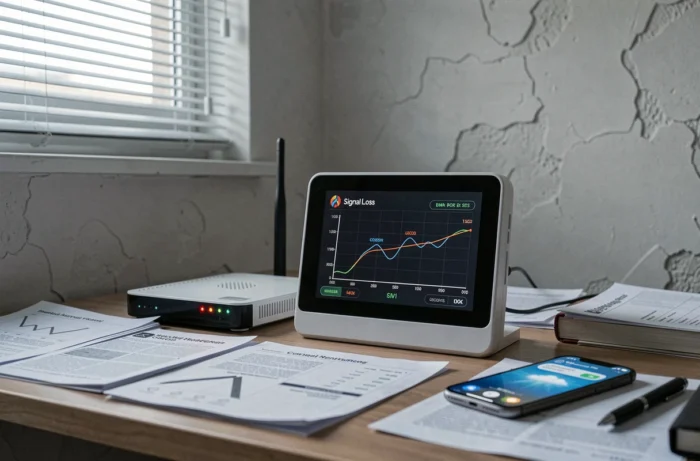
The La Crosse Technology case illustrates the risk of an architecture where the device depends on a cloud service or a third-party network to display basic data. In contrast, a station whose probe communicates exclusively in local RF with the console remains functional regardless of any external operator.
Recent Wi-Fi models have an advantage (firmware updates, remote access) and a structural disadvantage: if the manufacturer’s server shuts down, some functions disappear. Before purchasing, we recommend checking if the station displays data from the local probe even without an internet connection. Models that condition the display of the outdoor temperature on a cloud connection replicate exactly the pattern that rendered La Crosse stations unusable.
- Prefer a station capable of displaying temperature and humidity in pure local RF mode, without network dependence.
- Check the availability of compatible replacement probes from the manufacturer (risk of supply disruption on end-of-cycle models).
- Ensure that the transmission protocol between the probe and console is not proprietary and closed, which would prevent any future interoperability.
The shutdown of the eMessage network has also accelerated discussions around the planned shutdown of 2G and 3G networks in France, which affects other connected devices beyond weather stations. Users of IoT devices dependent on these cellular networks face the same type of short-term risk.
The choice of a reliable weather station relies less on the accuracy of the sensor than on the longevity of its transmission channel. A device whose probe communicates in local radio, powered by lithium batteries, installed outside of shadow zones and away from sources of interference, covers the vast majority of use cases without depending on a third party that may disappear.