Food-grade 90° alcohol for fruits has never been an easy product to find in supermarkets. At Leclerc, the situation has become complicated in recent years: several stores have removed this item from self-service, without a uniform decision at the national level. The result for those wanting to prepare fruits in brandy or homemade liqueurs is a shopping journey that has become unclear, between the household goods aisle, the spirits section, and online Drive.
90° food-grade alcohol and household alcohol at Leclerc: a confusion to clear up
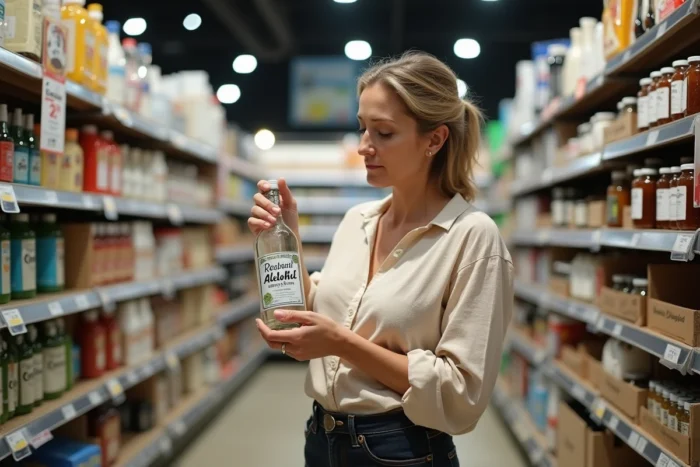
The most common trap is found in the household goods aisle. The bottles of 90° alcohol sold there are, in the vast majority of cases, denatured household alcohol, reserved for cleaning. The degree displayed on the label may be identical to that of food-grade alcohol, but the composition differs radically.
Denatured alcohol contains additives (bitrex, camphor, or other agents) that render it unfit for consumption. Its legal status is not that of a food product. Using it to macerate fruits or prepare a liqueur poses real health risks.
To identify food-grade alcohol, three elements must be checked on the label:
- The mention “neutral agricultural alcohol” or “alcohol for fruits” – any reference to household use excludes consumption
- The absence of denaturing agents in the ingredient list (bitrex, added methanol, camphor)
- The presence of a food lot number and a volume expressed in cl or liters, along with the alcohol by volume percentage
Those looking to find where to find 90° food-grade alcohol for fruits at Leclerc should therefore systematically check the product’s origin aisle and the exact nature of what they put in their cart.
Gradual disappearance of neutral 90° alcohol from Leclerc shelves
Since 2024-2025, several Leclerc centers have removed 90° alcohol for fruits from self-service. The decision does not come from a national directive from the group, but from local choices specific to each store. A Leclerc in a rural area may still offer the item in the spirits aisle, while an urban hypermarket may have removed it.
This disappearance is part of a broader trend in large retail. The shelf space once occupied by neutral alcohol is gradually being redistributed to ready-to-consume spirits: white rums, vodkas, fruit brandies with an alcohol content between 37.5° and 55°. These products generate more margin and correspond to a more visible demand.
The internal charters of some Leclerc centers also limit the promotion of strong alcohols in paper catalogs. The product may exist in stock without ever appearing in a brochure, which reinforces the impression that it has disappeared.
Leclerc Drive: check availability before going
The most reliable reflex remains to go through the Drive site of your local Leclerc. Some references for fruit alcohol appear online even though they no longer feature in the catalog. Searching with keywords “alcohol for fruits” or “neutral alcohol” on the Drive allows you to quickly see if the product is available in your store.
Two scenarios arise. If the reference appears, you can reserve it and pick it up at a collection point, avoiding wandering the aisles for nothing. If it does not appear, a call to the store’s customer service can clarify the situation: the product is sometimes stored in reserve, accessible upon request at the spirits counter.
Field reports vary on this point. Some stores direct customers to the alcoholic beverages aisle, others to the reception, without apparent logic. The only constant is the lack of standardization from one Leclerc to another.
Alternatives to Leclerc for high-concentration food alcohol
When the nearest Leclerc does not offer the product, other avenues are worth exploring.
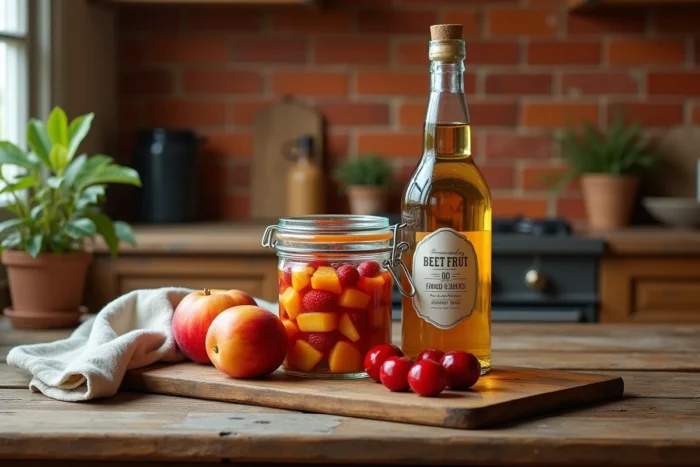
Local distilleries and wine cooperatives are becoming an increasingly used source. They offer neutral drinking alcohol with an alcohol content between 70° and 96°, explicitly sold as a food product intended for fruit preparations and liqueurs. The price per liter is often higher than in supermarkets, but the traceability and quality of the product are generally superior.
- Pharmacies sometimes sell food-grade alcohol by order, although this practice is becoming rarer
- Some specialized distillation equipment websites offer food-grade neutral alcohol with delivery, subject to checking the legal conditions for distance sales
- Farmers’ markets and agricultural fairs, particularly in wine regions, occasionally offer this reference
Fruit brandy at 40° sold in the spirits aisle can also serve as a base for macerations, although the result differs from a preparation with 90° neutral alcohol. The lower concentration extends the maceration time and alters the flavor profile of the finished product.
Label and degree: what guarantees safe food use
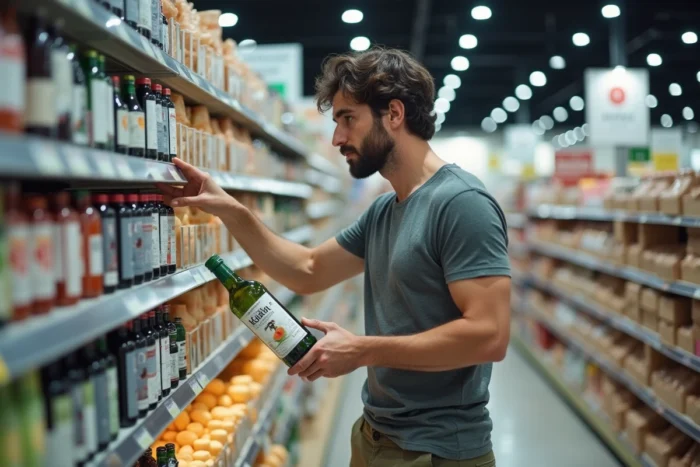
The alcohol degree alone is not enough to qualify a product as food-grade. A 90° alcohol can be denatured, and a 70° alcohol can be perfectly suitable for fruit jars. It is the mention “suitable for consumption” or “food use” that counts, not the number on the label.
For canning cherries, plums, or other fruits, an alcohol content between 40° and 90° works. The higher the degree, the longer the preservation and the faster the extraction of flavors. A 40° alcohol will require several additional weeks of maceration compared to a 90°, but the final product will be smoother in the mouth.
The stability of the product over time also depends on the container. Glass jars with rubber seals remain the safest choice for prolonged storage. Food-grade plastic may be suitable for short-term storage, but it allows more oxygen to pass through over time.
Purchasing food-grade alcohol for fruits at Leclerc remains possible, but it now requires prior verification via Drive or a direct call to the store. The disparity between the centers in the network is unlikely to resolve in the short term, as each store manager retains a margin of decision over their assortment of strong alcohols.