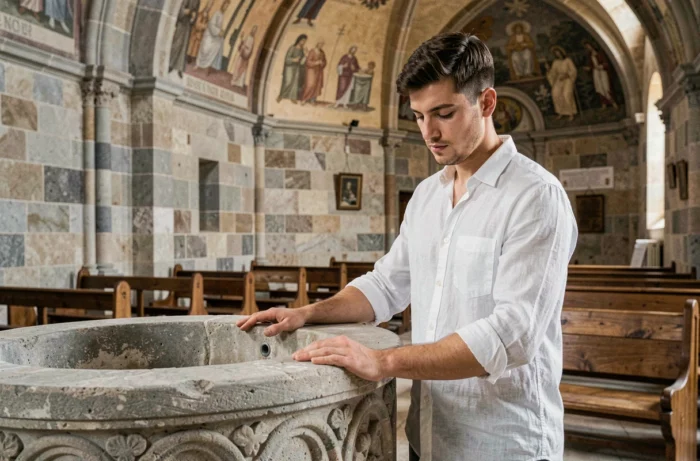
The name Baptiste carries a layer of meaning that its recent popularity tends to overshadow. Derived from the Greek baptizein, which means “to immerse” or “to plunge into water,” it refers to a specific ritual gesture, well before its adoption as a civil name. Before becoming a common choice in French maternity wards, Baptiste traversed centuries of religious, artistic, and administrative history.
From ritual gesture to qualifier: Baptiste before being a name
Baptiste was not conceived as a name. The Latin term baptista, derived from Greek, functioned as an adjective. It served to qualify John, the prophet who practiced baptism by immersion on the banks of the Jordan River in Palestine.
This John, a central figure of early Christianity, led a community in the Judean desert. His act of purification by water, applied notably to Jesus, earned him this distinctive qualifier. Tradition holds that he recognized in Jesus the “Lamb of God” before being beheaded by order of the tetrarch Herod Antipas.
The association between the word “baptist” and the figure of John was so strong that for centuries, using Baptiste alone, without Jean, made no sense. It was not an autonomous name but an identity complement linked to a particular saint. To delve deeper into the meaning of the name Baptiste, one must return to this distinction between ritual adjective and civil name.

Jean-Baptiste then Baptiste alone: a slow separation in the French civil registry
In France, the compound name Jean-Baptiste dominated for several centuries. The Council of Trent in the 16th century reinforced the use of saint names at baptism, and Jean-Baptiste was among the most frequent choices in parish registers.
Baptiste used alone is a recent phenomenon in historical terms. As long as the Catholic Church regulated the choice of names, separating Baptiste from Jean remained marginal. French law long mandated that names be drawn from the calendar of saints or ancient history. It was only with the gradual relaxation of this rule, particularly from 1966 and then with the 1993 law that liberalized the choice of names, that Baptiste could circulate autonomously.
This lexical emancipation is not trivial. It transforms a religious qualifier into a secular name, detached from the Johannine figure. Parents who choose Baptiste today do not necessarily think of John the prophet of the Jordan.
Two feasts, two narratives: the liturgical calendar of Baptiste
The name Baptiste retains a double liturgical anchoring, inherited from its link with Saint John. Two dates mark the calendar:
- June 24, the feast of the nativity of John the Baptist, one of the few Christian feasts celebrating a birth rather than a death. It coincides with the summer solstice, which is no calendar coincidence.
- August 29, the commemoration of the beheading of John the Baptist, an episode linked to the story of Herod Antipas and Salome in the synoptic gospels.
Celebrating a birth at the summer solstice is a deliberate theological choice. The Church Fathers placed the nativity of John six months before that of Jesus (December 25), relying on the Gospel of Luke. The symbolic play between increasing light (Christmas) and decreasing light (June 24) structures the entire liturgy around these two figures.

Baptiste in the arts: a name become an iconographic motif
The figure of John the Baptist has generated considerable artistic production, and the word “Baptiste” appears as a visual as well as textual marker. In painting, from Leonardo da Vinci to Caravaggio, the Baptist is represented with codified attributes: animal skin, reed cross, lamb.
In theater, the character of Baptiste in the film Les Enfants du paradis (Marcel Carné, 1945) gave the name a second cultural life in France, this time completely detached from the religious context. The mime Baptiste Deburau embodies a romantic archetype, that of the silent and passionate artist.
This dual lineage, religious and artistic, partly explains why Baptiste resonates differently across generations. For the older generation, it evokes the saint of the Jordan. For others, it carries a more poetic or theatrical connotation.
Greek etymology of Baptiste: what the word reveals about the rite
The etymological journey of Baptiste deserves a pause. The Greek baptein means “to plunge into water,” with a strong physical connotation. It is not about sprinkling but fully immersing. The derived baptizein adds a ritual dimension to this gesture.
This distinction between total immersion and sprinkling has fueled theological debates for centuries, particularly between Catholics and certain Protestant communities. The name Baptiste thus carries, in its very root, the trace of a doctrinal controversy over the correct form of baptism.
Three layers of meaning coexist in this name:
- The physical gesture (to plunge into water), inherited from the Greek baptein.
- The sacred rite (to administer the sacrament), carried by the Latin baptista.
- The contemporary civil identity, where Baptiste functions as an autonomous name without explicit religious charge.
The shift from gesture to identity has occurred over nearly two millennia. Baptiste remains one of the few French names whose etymology describes a precise physical action, rather than an abstract quality (like Clément or Prudence). This particularity gives it a semantic density that its apparent trivialization should not obscure.