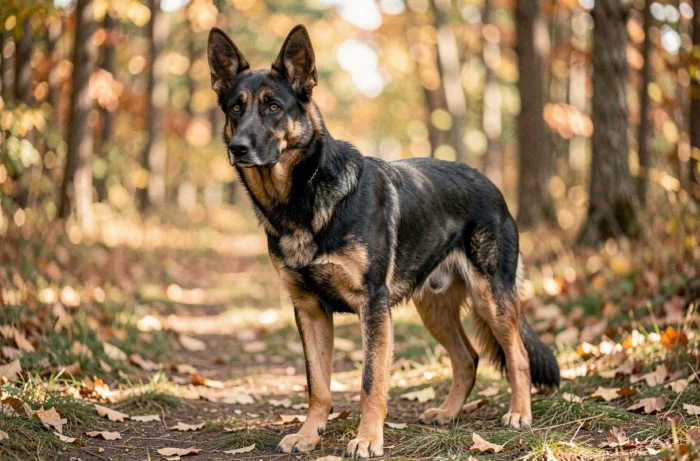
The German Shepherd and Beauceron cross produces an adult dog whose character cannot be reduced to the sum of two breed profiles. Each individual inherits a variable mix of behavioral traits, making temperament prediction more complex than with a purebred dog. Understanding what distinguishes the two parental lines helps to better grasp the behaviors observed in adulthood, and especially to identify specific points of vigilance.
Behavioral Maturity of the German Shepherd Beauceron Cross: A Gap to Be Aware Of
A trait rarely addressed in general guides concerns the gap between physical maturity and behavioral maturity. The Beauceron, in particular, exhibits a prolonged adolescence. A crossbreed may reach its adult size well before stabilizing its temperament.
According to a profile of the Beauceron published by AnimalGuesser (August 22, 2026, updated September 7, 2026), the adolescent phase may remain pronounced in young adults. Specifically, a two-year-old dog, physically imposing, may still test the limits of the framework set by its owner. This gap surprises owners who associate adult size with stabilized behavior.
In contrast, the German Shepherd tends to channel itself earlier within a structured framework. In the crossbreed, the duration of this testing phase heavily depends on the dominant lineage, but also on the consistency of education maintained daily. A relaxation of rules between one and three years produces more lasting effects than with other dog profiles.
To better understand the specific behaviors associated with this profile, the adult German Shepherd Beauceron cross displays combinations of traits that neither breed manifests in isolation.
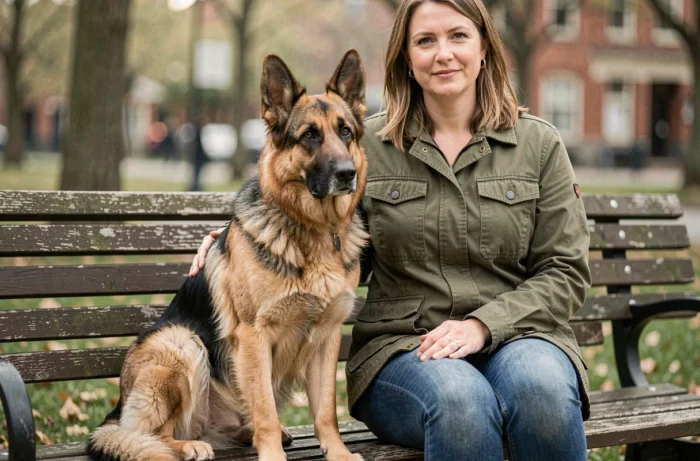
Inherited Character Traits: Comparative Table of Beauceron and German Shepherd
Rather than listing generic qualities, it is more useful to compare the documented behavioral trends of each parent breed and observe how they combine in the adult crossbreed.
| Behavioral Trait | Beauceron | German Shepherd | Adult Crossbreed (Observed Trend) |
|---|---|---|---|
| Relationship with Owner | Conditional loyalty to perceived leadership | Strong, sometimes exclusive attachment | Marked loyalty, but tests the legitimacy of the framework |
| Tolerance of Peers | Variable, frequent selectivity in males | Generally sociable if socialized early | Risk of intolerance between adult males |
| Independence | Strong, takes initiatives alone | Moderate, seeks validation from the owner | Notable autonomy, cooperation if the framework is clear |
| Protective Instinct | Very pronounced, territorial | Pronounced, family-oriented | Combined territorial and family protection |
| Mental Stimulation Needs | High | Very high | Daily needs above average |
The central point of the table: the crossbreed combines the independence of the Beauceron and the intensity of the German Shepherd. This combination produces a dog capable of making decisions on its own while remaining very responsive to its environment. An advantage in work situations, a challenge in daily life without an appropriate educational framework.
Educational Consistency and Testing the Framework: The Real Challenge in Adulthood
AnimalGuesser (source updated in September 2026) emphasizes a point that competitors overlook: this type of dog quickly detects inconsistencies in the rules. If a behavior is prohibited in the morning and tolerated in the evening, the crossbreed registers it and exploits the loophole.
This mechanism is not disobedience, but a trait inherited from herding work. The Beauceron, like the German Shepherd, has been selected to assess situations and adapt its response. An owner who changes rules without apparent reason loses credibility in the eyes of the dog.
The concrete consequences in adulthood:
- A dog that obeys perfectly to one household member and ignores others because instructions differ from person to person
- Excessive guarding behaviors (barking, positioning between the owner and a visitor) if territorial limits have not been consistently established
- A tendency to anticipate commands, even to preempt them, which may resemble obedience but indicates a gradual takeover
The solution lies in a uniform framework applied by all household members, without exception. It is not a matter of severity, but of clarity.
Coexistence with Other Dogs: A Specific Point of Vigilance
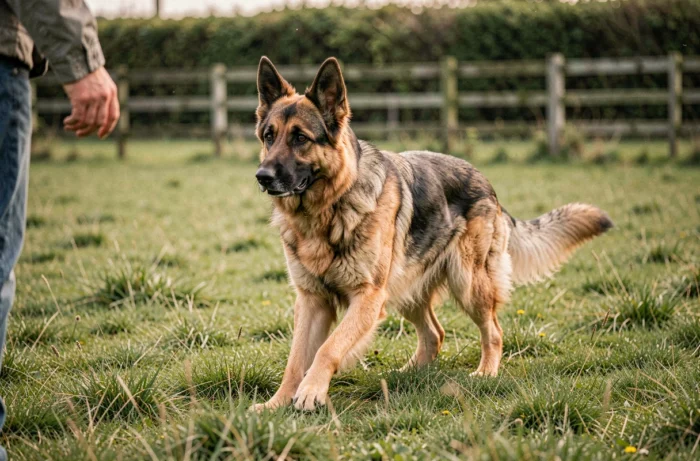
Recent sources (AnimalGuesser, September 2026) document an underestimated trait: some adult males may be selective, even intolerant, towards their peers. This behavior, inherited from the Beauceron, manifests mainly after social maturity, often between two and three years.
The early socialized German Shepherd generally gets along well with other dogs. However, the Beauceron component of the cross may introduce selectivity that did not exist during the puppy phase. An owner accustomed to positive interactions in the dog park may be surprised by a sudden change in attitude.
Early socialization remains the main lever. It does not guarantee the absence of conflict, but it provides the dog with a repertoire of calming signals that reduce escalations. For an adult crossbreed already set in its habits, management relies more on avoiding risky situations (off-leash walks with unknown males, for example) than on late re-education.
Physical and Mental Exercise: A Threshold Clearly Above Average
The need for daily activity far exceeds that of a standard companion dog. Both parent breeds are working dogs, selected for hours of sustained effort. An adult crossbreed that does not receive enough stimulation develops compensatory behaviors: destruction, barking, hyper-vigilance.
Physical exercise alone is not enough. A dog of this profile needs tasks that engage its intelligence: tracking, searching for objects, advanced obedience, or any activity that involves its problem-solving ability. A long daily walk constitutes a minimum, not a goal.
- Plan for at least two active outings per day, one of which includes a mental component (outdoor obedience exercises, search games)
- Alternate environments to maintain sensory stimulation
- Integrate the dog into a regular activity (canicross, herding work if possible, agility) to channel its work energy
The adult German Shepherd Beauceron cross is not a difficult dog. It is a readable dog, provided one understands that its cooperation is earned through consistency, not coercion. Owners who maintain a clear framework, appropriate exercise, and ongoing socialization have a remarkably reliable companion.