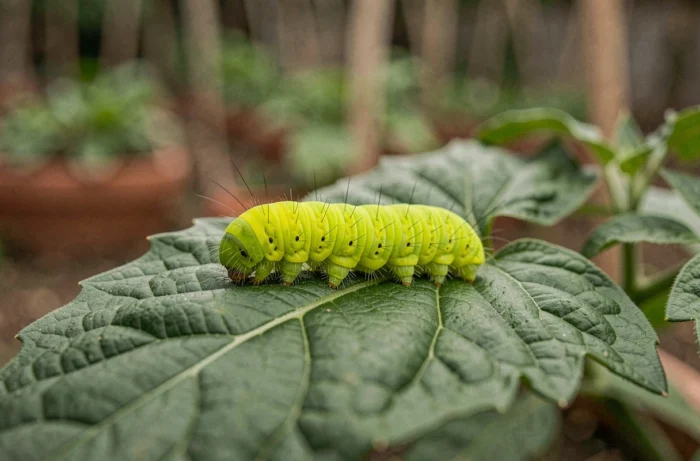
The fluorescent green caterpillar refers to several species of lepidopteran larvae whose bright green color, sometimes almost fluorescent, signals an adaptation for camouflage among foliage. In the vegetable garden, their presence often provokes a disproportionate reaction compared to the actual risk they represent.
Development cycle and peak activity of green caterpillars in the vegetable garden
Understanding the biological cycle of these caterpillars allows for better anticipation of their damage. After the adult butterfly lays eggs on the leaves, the larvae hatch and go through several stages before pupation. Each stage corresponds to a molt, and it is during the last stages that the caterpillar consumes the most foliage.
The peak of attacks occurs in June-July, when high temperatures accelerate the metabolism of the larvae. A second generation may appear in late summer or early autumn on late crops, which explains the damage sometimes observed on late-season cabbages or lettuces planted in August.
This seasonal phenomenon is described as expanding on a European scale, with milder winters favoring the survival of pupae in the soil. To learn everything about the fluorescent green caterpillar, it is first necessary to distinguish the truly harmful species from those that cause only cosmetic damage.
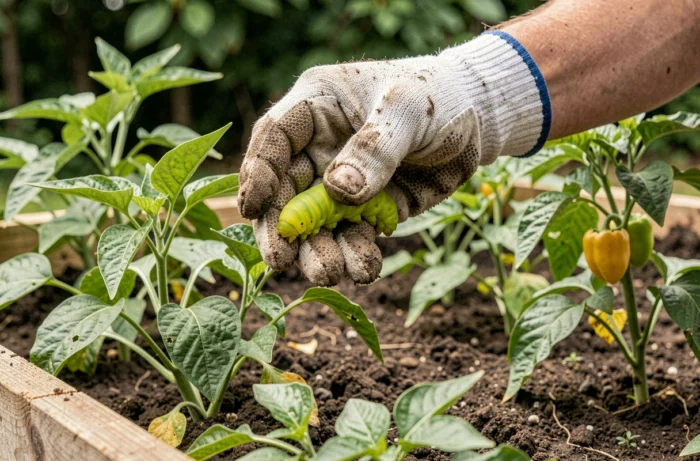
Fluorescent green caterpillar: distinguishing harmless species from pests
Not all green caterpillars deserve the same treatment. Confusion between species often leads to the elimination of larvae that are beneficial to garden biodiversity.
Smooth and harmless green caterpillars
The caterpillar of the sphinx of the privet is one of the most spectacular. Its bright green body bears oblique white and purple stripes, with a horn-like appendage at the back. Despite its impressive appearance, it poses no danger to humans and primarily feeds on privet, lilac, or ash, not on vegetable crops.
The caterpillar of the swallowtail, recognizable by its black bands and orange spots on a green background, consumes the leaves of carrots, fennel, and parsley. Its damage remains limited, and the butterfly it produces is one of the most remarkable in European fauna.
Measuring worms (or inchworms) move by forming a characteristic loop with their bodies. Their small size and moderate consumption rarely make them a problem in the vegetable garden.
Truly problematic green caterpillars
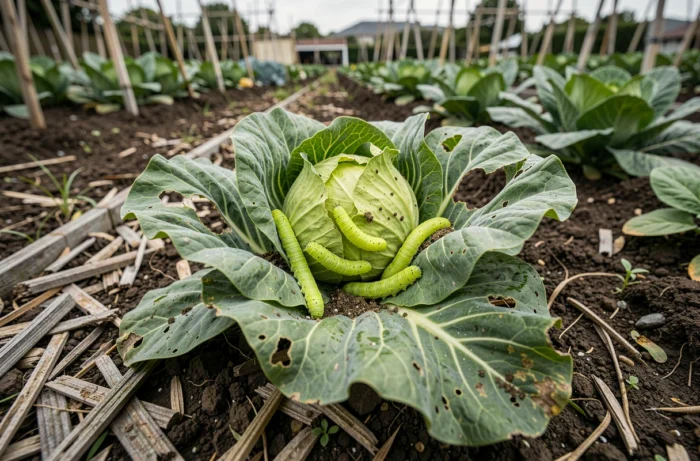
The cabbage white is the real scourge of the vegetable garden. Its yellow-green caterpillars speckled with black dots attack brassicas (cabbages, broccoli, turnips) in colonies. Their collective appetite can reduce a plant to its veins in just a few days.
Some nocturnal moths lay eggs in the soil, and their green larvae nibble on young plants at the collar, causing losses in salads and tomatoes. They are harder to spot because they feed at night and hide in the soil during the day.
- Smooth, solitary caterpillar on an aromatic or ornamental plant: probably harmless, leave in place.
- Caterpillar in a group on a cabbage or broccoli, with visible droppings: cabbage white, intervention justified.
- Hairy or spiny caterpillar with skin reaction upon contact: potentially stinging, handle with gloves.
Regulations and stinging caterpillars: what has changed
Since April 25, 2022, a French decree classifies processionary caterpillars as harmful to human health. This classification imposes a management obligation on property owners for infestations on their land. In municipalities that have issued a specific order, financial penalties may apply in case of inaction.
Processionary caterpillars (of pine or oak) are not green, but this regulation concerns any gardener who might confuse a stinging green caterpillar with a processionary one. The distinction lies in the hairiness: processionary caterpillars have thousands of microscopic hairs released into the air, while smooth fluorescent green caterpillars do not have stinging hairs.
If in doubt about a hairy caterpillar found in the garden, the official recommendation is to contact the town hall, which can direct you to a certified professional. Never touch a hairy caterpillar with bare hands, even if it appears green and harmless.
Control methods suitable for the vegetable garden without pesticides
The choice of method directly depends on the identified species and the extent of the infestation.
The Bacillus thuringiensis kurstaki (Btk) remains the reference biological solution against defoliating caterpillars. This bacterium, sprayed on the foliage, is ingested by the caterpillar, which stops feeding within hours. Btk is selective: it only affects the larvae of lepidopterans that consume the treated leaves, sparing bees and beneficial insects.
The insect net placed over brassica crops as soon as they are planted prevents the laying of cabbage whites. This physical barrier is the most reliable method for cabbages, provided that the net is properly secured to the ground without leaving any gaps.
- Daily manual collection in the morning, when the caterpillars are less active and more visible on the undersides of the leaves.
- Spraying Btk in the late afternoon, as the bacterium is sensitive to UV and degrades in direct sunlight.
- Crop rotation to disrupt the cycle of species tied to a family of plants, particularly cabbage whites on brassicas.
- Installation of blue tit nesting boxes: a family of blue tits consumes a considerable volume of caterpillars during the chick feeding period.
The use of nematodes (Steinernema feltiae or Steinernema carpocapsae) is an alternative for severe infestations. These microscopic organisms parasitize caterpillars in the soil, making them particularly suitable against soil-dwelling nocturnal moths.
The presence of a few green caterpillars in the vegetable garden does not necessarily justify intervention. A garden that hosts caterpillars also welcomes their natural predators, and the butterflies that emerge from these larvae contribute to the pollination of crops. Removing all caterpillars would impoverish an ecosystem from which the vegetable garden directly benefits.