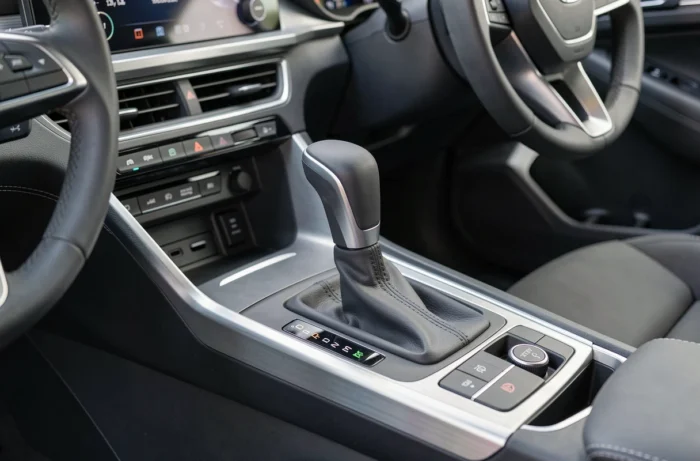
On a a gently sloping parking lot, engine barely started, the e-DCS6 gearbox hesitates between first gear and electric mode. The left foot searches for a clutch that doesn’t exist, and the car moves forward in jerks. This kind of scene sums up the first weeks with the Hybrid 136: a transmission that requires an adjustment period, both for the driver and for the system itself.
Jerks at low speed: what break-in changes on the e-DCS6
The most frequently mentioned point in user feedback concerns transitions at very low speeds. During parking maneuvers or in stop-and-go traffic, the dual-clutch automated gearbox can produce noticeable jerks. You can feel the system hesitating between electric traction and engaging the thermal engine, sometimes with a slight unpleasant jolt.
According to field feedback published by Rognac Auto after 20,000 km driven, the behavior becomes significantly smoother after a few thousand kilometers. Calibration seems to improve with break-in, and transitions gain in fluidity. Before this milestone, you learn to slightly lift your foot as you approach friction zones to anticipate gear shifts.
In practice, it is noted that the e-DCS6 transmission on the Hybrid 136 divides opinions precisely on this point. Those who drive a lot in the city, with frequent stop-and-go situations, feel these initial jerks more than those who take mixed or highway trips.
Thermal management in summer: when electric assistance takes a back seat
One aspect rarely addressed in standard tests concerns the behavior of the 48 V system in high heat. Rognac Auto’s feedback mentions that in summer, after several cycles of stop-and-go, electric assistance significantly decreases in urban driving. The low-capacity battery (less than 1 kWh gross) heats up, and the thermal management system restricts the electric machine to protect the components.
In practice, you then lose the benefit of electric mode at startup and during slow rolling phases. The thermal engine takes over earlier, which increases consumption in the city precisely when hybridization should provide the most. Feedback varies on this point depending on regions and usage conditions, but it’s a parameter to be aware of if you regularly drive in the south or in dense urban areas during the height of summer.
Adapted operation on roads and highways
Outside of these extreme situations, the Hybrid 136 finds its best level on the road. Gear transitions are more decisive, the electric motor effectively assists acceleration between 50 and 90 km/h, and consumption decreases significantly compared to a classic PureTech. It is on this type of journey that the e-DCS6 gearbox shows its true added value.
Particularly appreciated is the coasting mode (sailing) on downhill stretches or at stabilized speeds. The thermal engine shuts off, the car moves on its momentum, and instant consumption drops to zero. This mode operates transparently, without driver intervention.
Software updates: a concrete purchasing criterion
With this type of electrified transmission, the software that controls the transitions between thermal and electric plays a central role. And on the Hybrid 136, the history of dealership software updates has become a real selection criterion, especially for used car purchases.
Vehicles may exhibit malfunctions (electric mode unavailable, erratic gear shifts) simply because a software update campaign has not been applied. No warning lights illuminate, and no clear faults appear in a quick diagnostic. The problem only reveals itself in use, complicating identification.
Before signing, here are the points to check:
- Request from the dealership the list of software campaigns applied to the vehicle, along with intervention dates
- Check that the firmware of the e-DCS6 gearbox corresponds to the latest version available for the model year
- Test the vehicle in real-world maneuvering conditions (parking, parallel parking, traffic jams) for at least ten minutes when cold
- Ensure that electric mode engages properly at startup and during deceleration phases
Hybrid 136 e-DCS6 in daily use: for what type of driver
The Hybrid 136 is not a full hybrid. You don’t drive in all-electric mode for several kilometers like with a Toyota HSD or Renault E-Tech system. The 28 hp electric motor serves as support: starting, acceleration assistance, coasting. This is a supplementary hybridization, not a substitute hybridization.
This technical positioning is particularly suited for mixed use, with a majority of peri-urban and highway trips. A driver who mainly does pure city driving, with constant stop-and-go and frequent parallel parking, will be more exposed to the limitations of the automated gearbox. Those who take trips of several dozen kilometers on highways will get the most out of it.
Real consumption and positioning against diesel
In mixed use, long-distance tests published by L’argus on the 308 position this engine as a credible alternative to diesel in terms of consumption. The gain is particularly noticeable on roads and in peri-urban areas, less so on highways where the thermal engine runs at higher revs and where electric assistance is minimal.
The additional cost at purchase compared to a classic PureTech is gradually offset by reduced consumption, provided you drive enough. For low-mileage urban-only drivers, the economic calculation is less obvious.
The e-DCS6 transmission on the Hybrid 136 remains a young system. Its qualities on the road are real, but its limitations in maneuvering and under high heat deserve to be known before purchase. The software follow-up at the dealership, often overlooked, directly affects the quality of the driving experience.