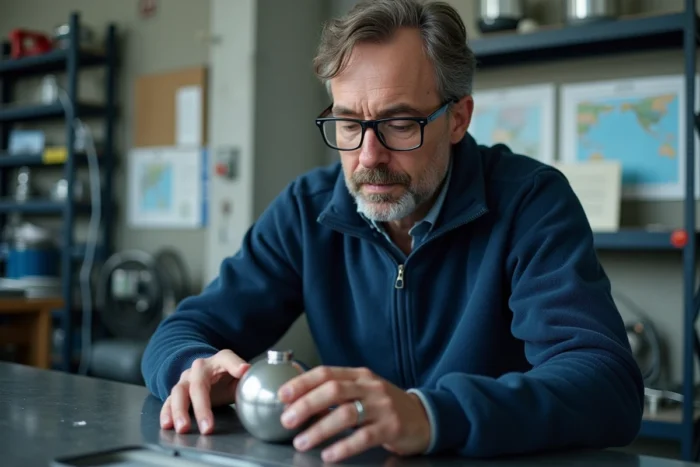
When a research vehicle descends to 3000 meters below the surface, every square centimeter of its hull withstands about 300 times atmospheric pressure. This mechanical stress conditions everything: the design of instruments, the survival of organisms, and even the carbon cycle in the deep ocean. Understanding underwater pressure at this depth means addressing a parameter that redefines physical, biological, and technological rules.
What 300 atmospheres do to a material
We often talk about pressure in bars or atmospheres, but in the field, the question is different: does the structure hold up, yes or no? At 3000 meters, the water column exerts a colossal force, and standard surface materials do not hold.
Titanium alloys and certain special steels are preferred for the hulls of submersibles. The glass used for observation portholes must be cut to considerable thicknesses. A microscopic defect in a seal, a poorly controlled weld, and the slightest structural weakness becomes a breaking point.
We saw this with the tragedy of the Titan submersible in 2023: pressure does not forgive any approximation. Pressure resistance certifications go through testing protocols where each component is subjected to loads exceeding real conditions. At this depth, there is no margin for error.
To delve deeper into this subject, an analysis of underwater pressure details the physical mechanisms that govern these forces at great depths.
Marine snow and pressure: the carbon cycle redrawn at 3000 meters
The consequences of underwater pressure are not limited to machines. They directly affect the environment and climate, through a process that was still poorly understood a few years ago: the transformation of marine snow under high pressure.
Marine snow consists of organic particles (plankton debris, excretions, aggregates) that slowly descend from the surface to the depths. They are the main vector for carbon transfer to the ocean floor.
What pressure changes between 2000 and 6000 meters
Experiments conducted by the University of Southern Denmark have shown that between 2 and 6 kilometers deep, pressure releases up to 50% of the carbon contained in marine snow. The phenomenon also releases more than 58% of the nitrogen from these particles. As a result, bacterial activity can increase by a factor of 30 in two days.
In practical terms, this means that a significant portion of carbon is remineralized before reaching the sediments. Carbon does not settle at the bottom as previously thought. It is recycled along the way, directly influenced by pressure.
For the climate, the implications are direct. If the deep ocean stores less CO₂ than estimated, our climate models need recalibration. The abyssal zone, between 3000 and 6500 meters, is now considered a key area for biogeochemical recycling, not just a passive reservoir.
Abyssal ecosystems: living under 300 atmospheres
At 3000 meters, we are in the abyssal zone. No light, a temperature close to 2 °C, and pressure that crushes any unadapted organism. The species that live here have developed radical adaptations.
- The cell membranes of these organisms contain specific lipids that remain fluid under high pressure, where surface membranes would become rigid and dysfunctional
- Some abyssal proteins adopt compression-resistant three-dimensional conformations, allowing them to function normally despite the ambient 300 atmospheres
- Abyssal organisms depend almost exclusively on marine snow for their energy supply, making them vulnerable to any changes in particle flow from the surface
Any disturbance in the marine snow flow directly affects these ecosystems. Climate change, by altering phytoplankton productivity at the surface, also changes the amount of organic matter that descends. The consequences for abyssal biodiversity remain difficult to measure, but the responses vary depending on the studied ocean basins.
Deep-sea mining: pressure as a barrier and a risk
The growing interest in polymetallic nodules from the abyssal plains places the question of underwater pressure at the center of a major environmental debate. These nodules, rich in manganese, nickel, and cobalt, are found precisely in the 3000 to 6000 meter zone.
Technical constraints and environmental impact
Extracting ores at this depth requires equipment capable of operating under hundreds of atmospheres for months. Pumping, cutting, and retrieval systems must withstand stresses that the offshore oil industry does not encounter at these levels.
The environmental impact goes beyond mere extraction. Scraping the seabed stirs up plumes of sediment that disperse over tens of kilometers. Under high pressure, these suspended particles interact with water chemistry in ways that are still poorly documented.
- The resuspension of sediments disrupts the bacterial communities that recycle carbon in the water column
- The vibrations and noise from extraction equipment propagate differently under high pressure, with poorly understood effects on abyssal fauna
- The removal of nodules eliminates a surface habitat for many sessile organisms, with estimated recovery times of several thousand years
The deep ocean is not an empty space to exploit. It is an environment where pressure shapes every physical, chemical, and biological interaction. Current protective measures, particularly those advocated by the International Seabed Authority, struggle to keep pace with exploitation projects.
The rise in ocean temperatures is also altering the stratification of water masses, which could change pressure and circulation conditions at 3000 meters in the long term. We are no longer talking about a stable and isolated environment, but an oceanic layer connected to surface climate dynamics, where every parameter matters.