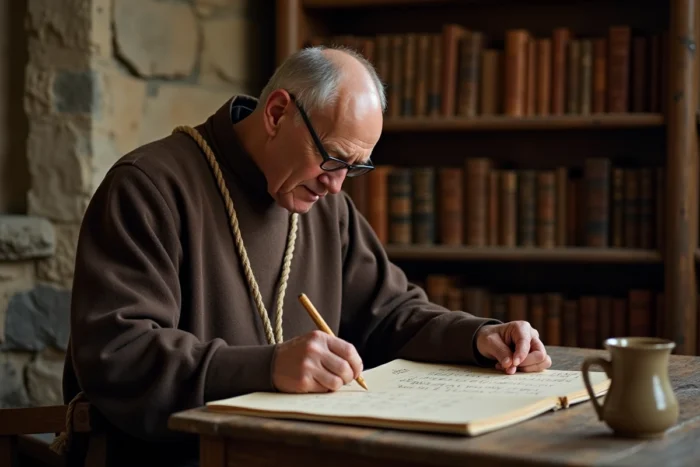
A Benedictine, Cistercian, or Carthusian monk does not sign any employment contract, does not receive any pay slips, and does not have any personal bank account. Talking about an annual salary for a Catholic monk in France is akin to searching for a budget line that simply does not exist. The economic reality of monastic life is based on a mechanism that is radically different from salaried employment.
Social Contributions and Protection of Monks in France
When looking at the situation of an employee, one thinks of pay slips, contributions deducted at source, and company health insurance. For a monk, the process is entirely different. The monastic community takes care of all the needs of its members: housing, food, medical care, clothing.
A monk does not receive any personal income. The vow of poverty, pronounced during religious profession, entails renouncing all individual property. The income generated by the monastery’s work (brewery, cheese factory, hospitality, crafts) is paid to the community, not to individuals.
Monasteries contribute to the Cavimac (Pension, Disability, and Health Insurance Fund for Religious), which grants health insurance and retirement rights for each religious member. You can find information about a monk’s salary on Bretagne Émeraude that details this particular functioning. A monk’s pension remains very modest, well below the national average for French retirees.
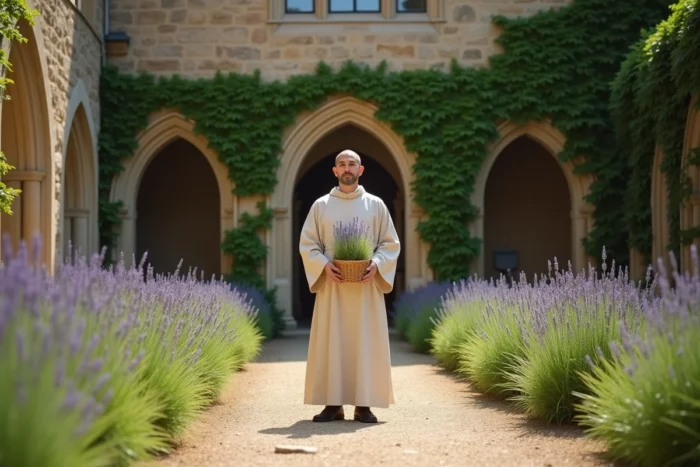
Monastic Life and Poverty Line: A Misleading Comparison
Insee sets the monetary poverty line at 1,337 euros of available monthly income for a single person. If we think in terms of personal cash flow, a monk is well below this threshold, with an individual available income close to zero.
This comparison is misleading. The actual standard of living of a monk is elevated by the provision in kind: a roof, three meals a day, heating, healthcare. None of these expenses weigh on a personal budget since that budget does not exist.
In practical terms, a monk does not need to pay rent, fill a shopping cart at the supermarket, or take out home insurance. The community absorbs all these expenses. The monastic economic model functions as a comprehensive support system without any salary compensation.
What the Community Covers Daily
- Complete accommodation in an individual cell, including building maintenance and heating, often in old abbeys whose renovation is costly for the monastic community
- Food, partly produced on-site (vegetable garden, orchard, cheese factory) and supplemented by bulk purchases for the entire community
- Social contributions paid to Cavimac, covering health, disability, and retirement for each religious member of the community
- Continuing education costs, spiritual retreats, and travel related to the community’s mission
Monastery Revenues: Where the Community’s Money Comes From
While monks do not receive anything individually, the monastery itself must balance its accounts. Revenue sources vary significantly from one abbey to another.
Manual labor remains the first pillar. According to the Rule of Saint Benedict, each monk contributes through his work to the community’s livelihood. Activities range from brewing beer or making cheese to printing and managing a retreat house. Some abbeys have developed real commercial brands, with online or retail distribution channels.
Donations from the faithful and bequests constitute the second source. The generosity of parishes and individual donors varies from year to year, making financial planning tricky for small communities.
The third source, often overlooked, concerns real estate income. Some monasteries own agricultural land rented to farmers, or buildings made available for cultural or tourist activities.
Difference Between a Monk and a Diocesan Priest
Confusion is common. A diocesan priest receives a monthly allowance paid by his diocese, estimated at around 1,000 euros net per month according to the French Bishops’ Conference. He also benefits from a residence (the presbytery) and fees for masses.
A monk, however, does not receive any personal allowance. Everything goes through the common fund of the monastery. The distinction is fundamental: the diocesan priest has an individual relationship with money (even modest), while the monk lives in a collective system where the very notion of personal income is abolished.
Retirement and End of Life of a Catholic Monk
The question of retirement is acute in aging communities. Thanks to contributions paid to Cavimac, a monk who has spent his entire life in community receives a pension, but this remains very low compared to the average retirement in France.
When a monk becomes dependent, the community ensures his care for as long as possible. Abbeys that no longer have enough able-bodied members to care for the elderly sometimes have to call on external help, funded from the monastery’s own resources or through solidarity between congregations.
The financial situation of elderly monks directly depends on the economic health of their abbey. A dynamic community with a profitable commercial activity better protects its elders than a small struggling rural priory. Returns on this point vary according to orders and regions.
Reducing the life of a Catholic monk to an annual amount is to apply a salary reading grid to a system that rejects it by principle. The vow of poverty is not a symbolic posture: it concretely structures the relationship to money, property, and material security. What replaces the salary is a collective pact where the community guarantees everyone’s needs, as long as it has the means to do so.