The market for rainwater tanks intended for agricultural operations has significantly expanded in recent years. The emergency agricultural water law, adopted in the summer of 2026, sets a goal of doubling agricultural storage volumes by 2035 compared to 2020. This political trajectory encourages manufacturers and distributors to broaden their ranges, but it also complicates pricing for operators who must choose between various technologies and storage scales.
Flexible tanks, steel cisterns, concrete basins: very different orders of magnitude
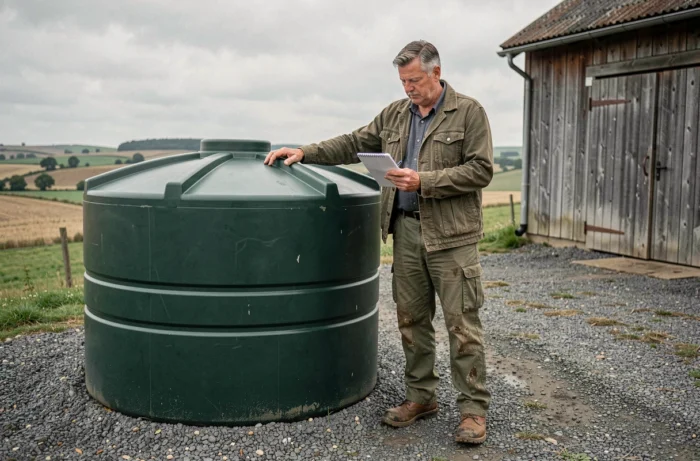
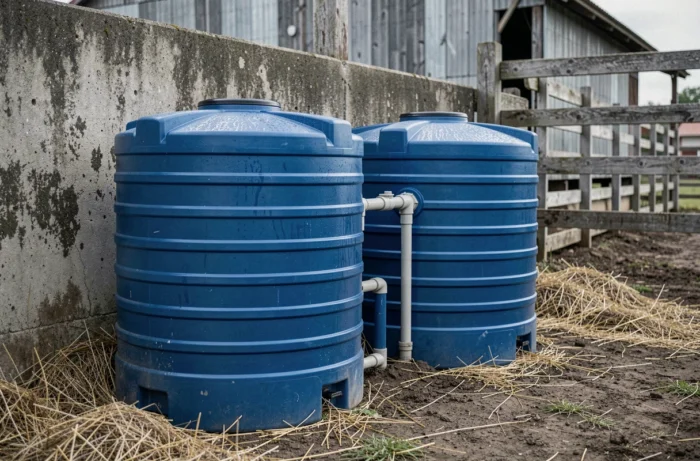
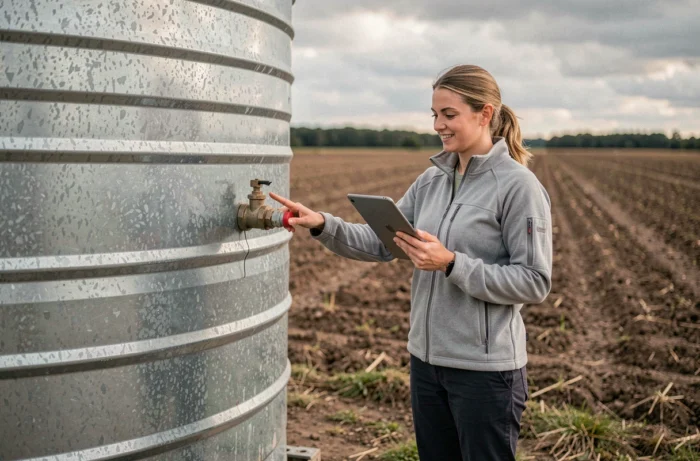
For an agricultural operation, the price question does not arise in the same way as for an individual installing a 1,000-liter rainwater collector at the foot of their gutter. The volumes in question range from 10,000 to 300,000 liters for flexible tanks, and steel cisterns can reach 200,000 liters. Concrete basins, on the other hand, are sized in hundreds, even thousands of cubic meters.
The prices published by Génération Entreprise confirm that budgets can reach several tens of thousands of euros for the largest structures. The price per stored liter decreases as capacity increases, but the entry ticket remains significant.
The choice of material affects both cost and lifespan. A flexible PVC tank can be transported and installed without heavy machinery, which reduces excavation costs. An underground concrete tank requires a more substantial construction site, with civil engineering costs that can represent half of the total budget.
CAPEX and OPEX in agriculture: two items that comparators overlook
Consumer-oriented pages compare the purchase prices of tanks without ever distinguishing between CAPEX (initial investment) and OPEX (operating expenses). For a farmer, this distinction changes the profitability calculation.
CAPEX includes the tank itself, any excavation, connection to gutters or collection surfaces, the lifting pump, and the filtration system. OPEX covers annual maintenance (cleaning, filter replacement, leak checks), the electricity consumption of the pump, and any repairs.
In an operation that irrigates several hectares, the cost of the pump and its electricity supply can exceed the cost of the tank itself over ten years. Field reports vary on this point: some operators report negligible maintenance costs on flexible cisterns, while others mention premature replacements due to UV exposure or freezing.
Often underestimated cost items
- Excavation and soil preparation, which vary greatly depending on the nature of the terrain (clay, rock, close water table)
- Connection to collection surfaces (roofs of barns, greenhouses), where the length of gutters and pipes can increase the bill
- Compliance with health standards if the collected water is used in contact with vegetable crops or for livestock watering
Emergency agricultural water law: a framework that alters the calculation
The emergency agricultural law adopted in the summer of 2026 does not just set a goal of doubling storage. It also provides for financial support mechanisms that directly modify the net price for the operator.
Regional project calls already exist. The Chambers of Agriculture in Brittany, for example, have opened a Agri-Invest project call until July 31, 2026, targeting, among other things, water storage infrastructures. In Guadeloupe, a similar project call has been extended for 2026. These aids do not cover the entire investment but can substantially reduce the remaining costs.
The implementing decree on hillside reservoirs, still awaiting publication in the summer of 2026, is another parameter to watch. According to parliamentarians urging the government to publish it, this text could simplify authorizations for agricultural storage structures and speed up processing times.
Regional aids and project calls: a fragmented landscape
The Rhône-Mediterranean-Corsica Water Agency offers funding for agricultural sectors favorable to water resources. The available data do not allow for a comprehensive national overview of subsidy rates, as each water agency and region applies its own eligibility criteria and limits.
For an operator, the process involves consulting their departmental Chamber of Agriculture and the water agency of their watershed before finalizing a quote. The financial arrangement can significantly affect the actual cost.
Selection criteria for sizing an agricultural tank in 2026
The necessary storage volume depends on three variables: the available roof area for collection, local rainfall, and the water needs of the operation (irrigation, watering, cleaning buildings).
- A large agricultural barn roof can collect several hundred cubic meters per year in well-watered areas, but barely half in the southeast of France
- The intended use determines the required level of filtration: simple field irrigation tolerates raw water, while animal watering or washing vegetables requires additional treatment
- The seasonality of demand is as important as the annual volume: an oversized tank that remains full for six months is costly for no reason, while an undersized tank forces reliance on the network during critical periods
Flexible tanks remain the most accessible option for intermediate volumes (10,000 to 50,000 liters) because they can be installed without foundations or building permits in most cases. For larger volumes, concrete or steel tanks offer longer durability but require a significantly higher initial budget.
The agricultural tank market in 2026 is structured around a tension between the urgency of storage, driven by the law, and the caution of operators facing heavy investments whose profitability depends on inherently uncertain climatic variables. Prices are likely to continue evolving as demand increases and public aids become clearer.