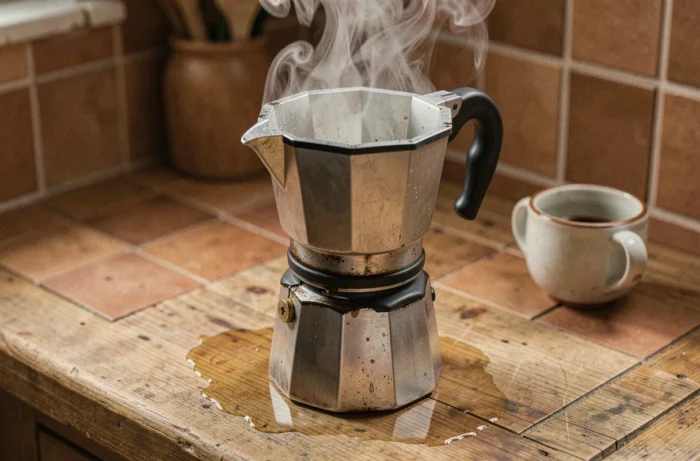
You unscrew the bottom of your Italian coffee maker after extraction, and there it is, surprise: a pool of water still stagnates in the lower chamber. This water residue in the moka pot is one of the most common questions among Italian coffee enthusiasts. Good news, this phenomenon has precise explanations, and it does not always indicate a problem.
The role of the tube and the internal geometry of the moka
Before talking about a malfunction, we need to look at what happens inside. The lower chamber contains the water, heated on the stove or hot plate. The steam and pressure push the water upwards, through the filter filled with ground coffee, and then into the upper part.
The central tube of the filter never reaches the exact bottom of the chamber. It stops a few millimeters above. This design detail is intentional: the filter tube always leaves an inaccessible pool of water.
When the pressure is no longer sufficient to push the remaining water, the extraction naturally stops. This is the moment when the coffee maker starts to sputter, a sign that only steam remains. The amount of residual water therefore directly depends on the length of the tube and the shape of the reservoir. A Bialetti Moka Express model and a Venus model do not leave exactly the same volume at the bottom, as their geometry differs.
To better understand the subtleties of this phenomenon, you can consult the Goûts et Passions website which details the causes of residual water according to coffee maker models.
Worn seal and limescale: when residual water increases
Have you noticed that the volume of remaining water has increased over time? This is a sign to take seriously. Two main factors explain this gradual degradation.
The tired sealing gasket
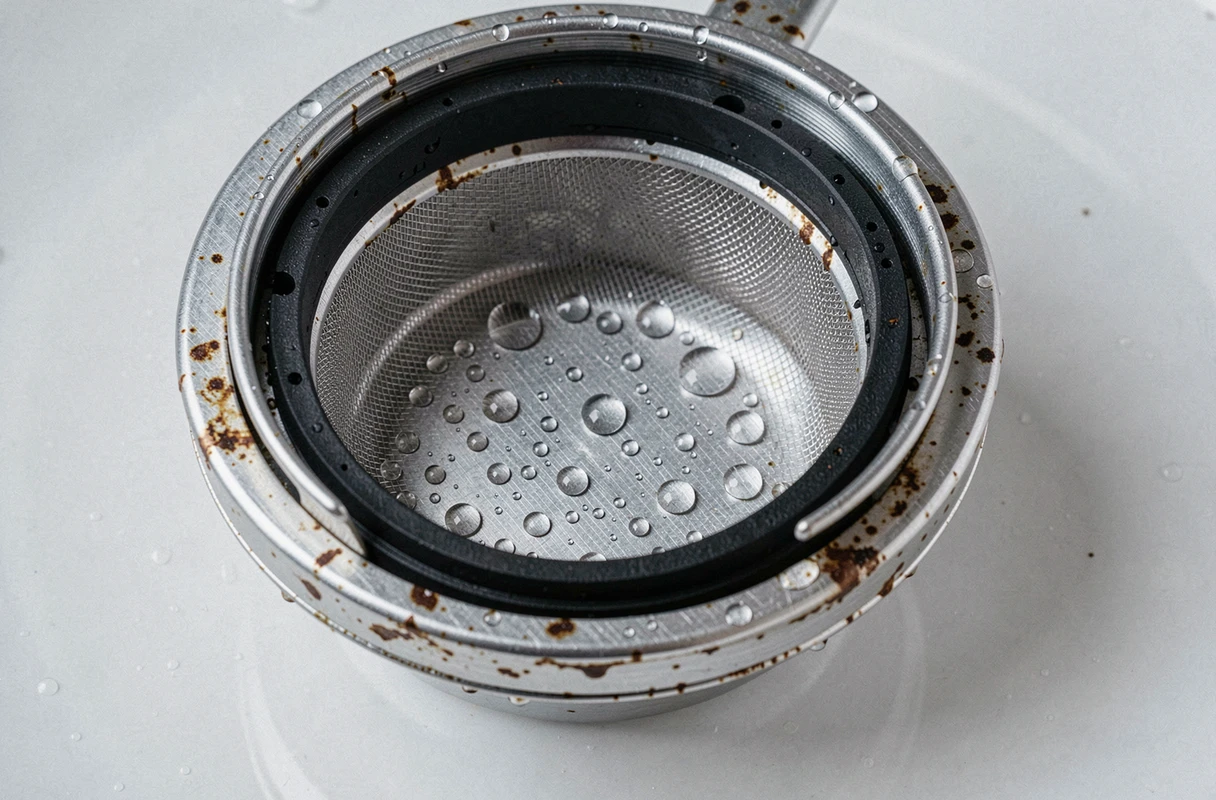
The rubber or silicone gasket that ensures the connection between the lower chamber and the upper part deforms with repeated heating cycles. A hardened or flattened gasket releases pressure from the sides instead of directing it upwards, through the ground coffee.
The result: the pressure in the chamber drops faster, the water is no longer pushed as effectively, and more remains at the bottom. If your gasket has lost its flexibility or shows cracks, replacing it often resolves the issue.
Limescale that hinders circulation
Tap water deposits limescale with each use. These deposits accumulate on the walls of the chamber, around the threading, and sometimes in the filter itself. Limescale reduces the flow of water and disrupts pressure buildup.
Regular descaling with white vinegar or diluted citric acid restores smooth circulation. Also, make sure that the small hole of the safety valve is not blocked by coffee or limescale residues.
Coffee grind and water level: two adjustments that change everything
The design of the coffee maker does not explain everything. Your preparation actions directly influence the amount of residual water.
- A grind that is too fine compacts the coffee in the filter and creates excessive resistance. The water struggles to pass through, the pressure rises too high, and the safety valve may even activate. Some of the water then remains trapped at the bottom.
- A grind that is too coarse allows water to pass through too quickly, without sufficient resistance. The extraction is fast, the coffee is diluted, but paradoxically, the chamber can also retain water if the pressure drops suddenly.
- The filling level also matters. The water should never exceed the safety valve. If you add too much, the pressure takes longer to build, and the heating cycle unnecessarily prolongs. If you add too little, the coffee maker sputters almost immediately.
The ideal grind for an Italian coffee maker is between espresso (very fine) and filter (coarse). A texture similar to fine salt yields good results. Never tamp the coffee in the filter: just place it, level it with your finger, and that’s enough.

When to worry about residual water in your Italian coffee maker
A pool of water after extraction is normal. All moka pots leave a residue, even new ones. The manuals of major brands confirm this: a certain volume of remaining water is compatible with correct operation.
However, some signals should alert you:
- The volume of residual water has significantly increased compared to the first uses.
- The coffee flows very slowly or no longer rises at all into the upper part.
- Water escapes between the two parts of the coffee maker during heating, a sign of a sealing defect at the gasket.
- The taste of the coffee has changed: excessive bitterness (overheating), flat taste (under-extraction), or metallic aftertaste (accumulated limescale).
In these cases, start by inspecting the gasket and the filter. Replacing these two parts is inexpensive and gives the coffee maker a second life. If the problem persists, check that the safety valve is functioning by gently pushing it with a pointed object: it should move freely.
The water residue does not affect the taste of the coffee as long as it remains moderate. It is when it gradually increases that action is needed. Regular maintenance (descaling, gasket replacement, filter cleaning) is usually sufficient to keep your Italian coffee maker in good working condition for years.