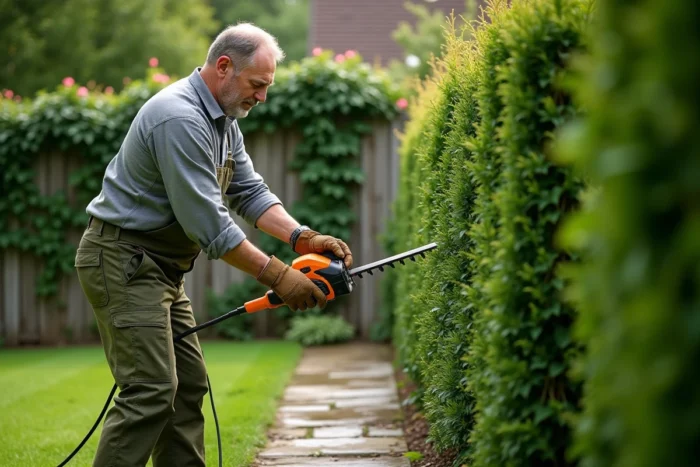
The thuja grows quickly, thickens each year, and produces woody shoots by the third season. Choosing a hedge trimmer suitable for this species means first understanding the nature of the wood to be cut: soft branches on the surface, but rigid stems over one centimeter in diameter if maintenance is delayed. An undersized device gets stuck, tears the bark, and leaves brown wounds that do not heal on a persistent conifer.
Blade spacing: the technical criterion imposed by thuja
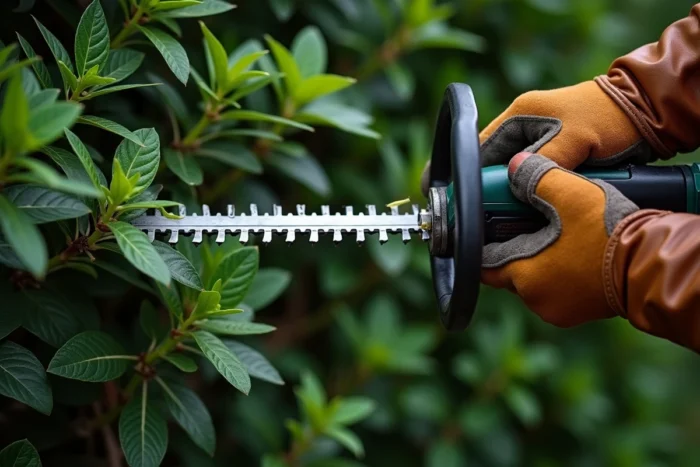
On a hedge trimmer, the spacing between the teeth of the blade determines the maximum diameter of branch that the tool can cut cleanly. For a thuja hedge trimmed twice a year, the year’s shoots rarely exceed one centimeter. A standard spacing is sufficient then.
The situation changes with less maintained or mature thujas. The branches easily reach two centimeters, sometimes more in the heart of the hedge. Too narrow a spacing causes jams: the motor struggles, the blades misalign, and the cut becomes fibrous. Prioritizing the right hedge trimmer for thujas means checking this spacing first, even before looking at the displayed power.
A spacing of at least 22 mm covers most situations on domestic thujas. For hedges neglected for several seasons, aiming for a larger spacing avoids unpleasant surprises.
Blade length for thujas: adapting the blade to the height of the hedge
The length of the blade determines the number of passes needed to cover the thickness of the hedge. An adult thuja commonly forms a wall 60 to 80 cm deep. With a short blade, several overlapping passes are required, which increases the risk of visible gaps on the surface.
A blade of 50 to 60 cm represents the best compromise for most residential hedges. It allows you to cut through the thickness in one or two passes while remaining manageable at arm’s length.
Beyond 60 cm, the blade gains coverage, but the device becomes significantly heavier. For a tall hedge exceeding two meters, a pole hedge trimmer with a medium-length blade is often more comfortable than a classic model with a long blade held vertically.
Battery, corded, or gas: what type of motorization for trimming thujas
The choice of motorization depends less on the plant species than on the terrain configuration and the length of hedge to be treated. The thuja does not require a specific motorization, provided that the motor torque is sufficient for the chosen blade spacing.
Corded electric hedge trimmer
The corded model offers constant power without autonomy limits. For thuja hedges at the property line, the extension cord remains the main drawback: beyond about twenty linear meters, managing the cable becomes cumbersome, especially at height.
Battery hedge trimmer
Recent battery models have made significant progress. High-end ranges now offer long blades and sufficient torque for thick branches, where these devices were previously reserved for light hedges a few years ago. The battery is now suitable for dense thujas, provided there is enough capacity to cover the entire length of hedge without interruption.
Gas hedge trimmer
The gas model retains an advantage for very long stretches and intensive interventions. Its unlimited autonomy (as long as there is fuel) and high torque make it the tool for hedges several dozen meters long or very old thujas with particularly hard branches. Weight, noise, and engine maintenance are the trade-offs to accept.
- Corded: ideal for short hedges near a power outlet, with a limited budget and few mobility constraints.
- Battery: versatile for medium hedges, quiet, increasingly efficient on thick branches thanks to the latest generations of brushless motors.
- Gas: reserved for long stretches or very mature thujas that require sustained torque over time.

Trimming period for thujas: a regulatory constraint to integrate
Most gardening guides recommend two annual trims, in spring and late summer. This horticultural recommendation conflicts with the guidelines from the LPO and the French Office for Biodiversity, which request to avoid trimming between March 15 and July 31 to protect bird nesting.
Several regional professional calendars (Alsace, Pyrénées-Orientales) already incorporate this constraint and shift the first intervention to May, then the second between mid-August and mid-September. In practice, this means that the hedge will have grown more by the time of cutting, with longer and harder shoots than during an early trim in April.
The choice of tool must take this shifted calendar into account: a longer blade and generous spacing compensate for the additional growth accumulated during the protection period.
Maintenance of blades after trimming thujas
The resin from conifers clogs the blades much faster than that from deciduous trees. After each session, cleaning with alcohol or a specific resin solvent is necessary to prevent sticky deposits from jamming the cutting mechanism.
- Wipe the blades immediately after use, before the resin dries and hardens.
- Apply a lubricant along the entire length of the blade to reduce friction and prevent corrosion.
- Check the sharpening once per season: dull blades crush the shoots instead of cutting them, which promotes browning of the thuja.
Clean and sharp blades preserve the health of the thuja as much as they extend the lifespan of the device. Neglecting maintenance after cutting conifers reduces cutting capacity much faster than after trimming privets or laurels.