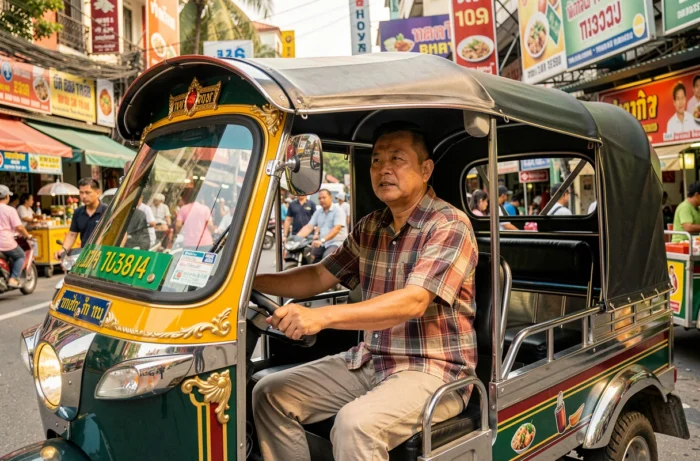
In Bangkok, a tuk-tuk driver parked in front of a tourist temple does not experience the same day as one who shuttles between a local market and a BTS station. Earnings depend on a handful of concrete variables, and the reality on the ground in 2024 strays from clichés about the small colorful vehicle.
Informal market and lack of regulated fare: how it changes daily life
The starting point is the complete absence of a meter. Unlike taxis in Bangkok, no national official fare applies to tuk-tuks. Each ride is negotiated verbally, between the driver and the customer, before starting.
This informality has a direct consequence: one cannot speak of a “salary” in the traditional sense. A driver does not receive a payslip, generally does not contribute to any social security system, and does not declare their income in a standardized way. The income of tuk-tuk drivers in Thailand varies from day to day depending on the area, the season, and the flow of tourists.
In practice, a driver positioned in a tourist area like Khao San Road or around the Grand Palace can charge significantly more than a driver operating in a suburban residential area. Feedback varies on this point, but the price difference between a “tourist” ride and a “local” ride can range from simple to triple for a comparable distance.
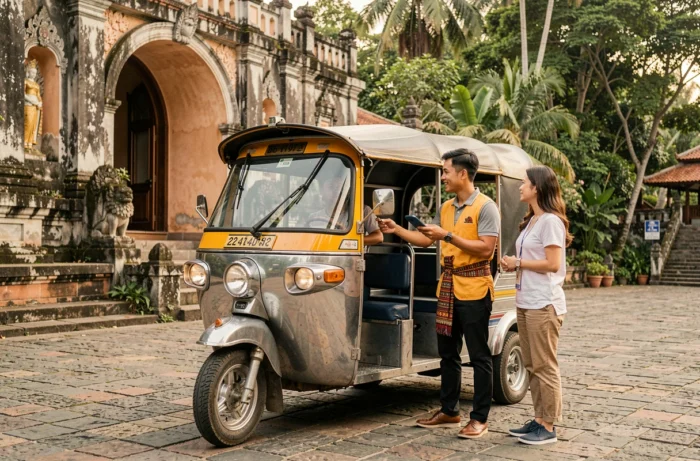
Fuel costs and expenses: the real profitability of a tuk-tuk day
Earning gross money is not enough. What matters is what remains after expenses. And for a tuk-tuk driver, the main expense is fuel.
Fuel, maintenance, and vehicle rental
Most drivers do not own their tuk-tuk. They rent the vehicle from an owner, often on a daily basis. This fixed rental takes a significant portion of the daily revenue even before the first ride.
Fuel represents another heavy expense. A classic combustion tuk-tuk consumes more than a scooter or a compact car for short trips in congested urban areas. The same trip can be profitable or not depending on the price of fuel at a given time of the year.
Mechanical maintenance (aging two-stroke engine, tires, brakes) and any fines also add up. In the end, the daily net income is significantly lower than what the tourist imagines when seeing the displayed price of a ride.
Electric tuk-tuks: a more profitable alternative
Electric models are starting to appear in the Thai landscape. Recent sources on the sector indicate that electric tuk-tuks have lower operating costs than combustion models. No fossil fuel, fewer wear parts, a reduced cost per kilometer.
For a driver, switching to electric could therefore improve the daily net margin. The obstacle remains the initial acquisition cost, which far exceeds that of a used combustion tuk-tuk.
Competition from taxis and ride-hailing apps: price pressure in 2024
The tuk-tuk does not operate in isolation. In Bangkok and major tourist cities, it faces competition that has intensified in recent years.
- Metered taxis often offer comparable, if not lower, fares, with air conditioning included, making them attractive for medium distances.
- Apps like Grab allow users to book a vehicle with a fixed price displayed in advance, removing the uncertainty of negotiation that characterizes tuk-tuks.
- Songthaews (shared pickups), in some cities like Chiang Mai, offer very low-cost collective transport on fixed routes.
The tuk-tuk must position itself for very short distances and on the tourist experience to remain competitive. On a journey of several kilometers, the rational customer often chooses Grab or a taxi. This constrained positioning limits the pricing power of drivers.
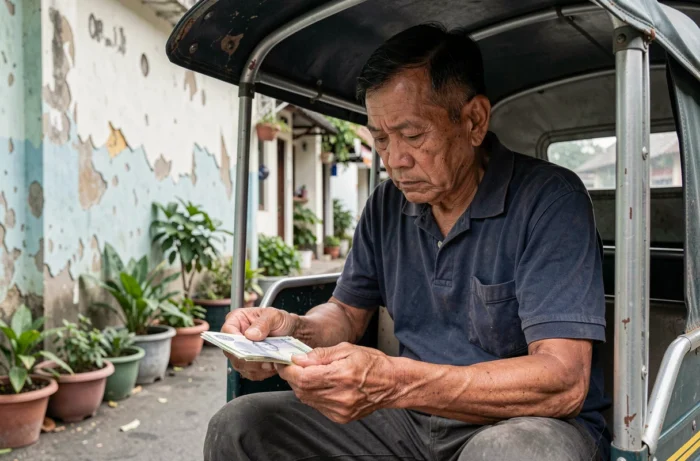
Seasonality and dependence on tourism: the low months weigh heavily
The income of a tuk-tuk driver follows the curve of tourist attendance. During the high season (from November to February approximately), areas like Sukhumvit, the old city of Bangkok, or the southern islands are bustling. Drivers chain rides, negotiate upwards, and can work late.
During the rainy season, it’s a different reality. Fewer foreign tourists, rides made uncomfortable by downpours (the tuk-tuk is open on the sides), and a drop in demand. For several months a year, drivers experience a marked decline in activity without a social safety net to compensate.
Le Figaro reported on the “blues” of tuk-tuk drivers in the face of the absence of tourists during the post-pandemic period. While attendance has picked up since then, the structural dependence on international tourism remains a factor of fragility for these independent workers.
Income of tuk-tuk drivers compared to the average Thai salary
To provide a reference point, one can compare what a tuk-tuk driver earns to what other workers earn in Thailand. The legal minimum wage in Thailand remains modest, and a large part of the workforce works in the informal sector with variable incomes.
An experienced tuk-tuk driver, well-positioned in a major tourist area and working long days, can exceed the local median income. In contrast, a driver in a non-tourist area often earns less than a metered taxi driver, who benefits from longer and more regular rides.
Disparities are therefore considerable along three axes:
- Geographical location (central Bangkok vs province, tourist area vs residential neighborhood)
- Season (high tourist season vs monsoon)
- Vehicle status (owner vs renter, combustion vs electric)
The profession of tuk-tuk driver in Thailand remains that of an independent worker in the informal sector, without standardized social protection, whose income fluctuates with the whims of tourists, fuel prices, and competition from digital platforms. The transition to electric could reshape profitability, but it remains currently limited to drivers capable of investing in a new vehicle.